|
09-26-2011, 05:21 PM
|
|
Free Member
|
|
Join Date: Jun 2011
Posts: 40
Thanked 1 Time in 1 Post
|
|
Hello everyone.
I would like everyone to tell me if the settings I am using to encode my VHS captured huffyuv files appear correct. I am attaching four pictures of the various settings I have and I want you to tell me if they seem correct or what I should change. I want to get the best possible quality but I don't know what a lot of these settings are. Any help would be greatly appreciated.
|
|
Someday, 12:01 PM
|
|
Ads / Sponsors
|
|
Join Date: ∞
Posts: 42
Thanks: ∞
Thanked 42 Times in 42 Posts
|
|
|
|
|
09-27-2011, 08:37 AM
|
|
Site Staff | Video
|
|
Join Date: Dec 2002
Posts: 13,661
Thanked 2,461 Times in 2,093 Posts
|
|
|
What's your output goal -- MPEG-2 for DVD, at 720x480? Or 352x480?
|
|
09-28-2011, 01:44 AM
|
|
Free Member
|
|
Join Date: Jun 2011
Posts: 40
Thanked 1 Time in 1 Post
|
|
Quote:
Originally Posted by lordsmurf

What's your output goal -- MPEG-2 for DVD, at 720x480? Or 352x480?
|
Mpeg2 for dvd. 720X480.
|
|
09-29-2011, 01:46 AM
|
|
Free Member
|
|
Join Date: Jun 2011
Posts: 40
Thanked 1 Time in 1 Post
|
|
|
Could someone please answer this question? I would really appreciate it.
|
|
09-29-2011, 11:38 AM
|
|
Site Staff | Web Development
|
|
Join Date: Jul 2003
Posts: 4,310
Thanked 654 Times in 457 Posts
|
|
|
A new guide is being written this weekend. That's going to be better than answers in the forum. There are several new guides being written this weekend, in fact, if time allows for all of them. It's going to be a massive overhaul to capturing guides, restoration guides and media guides. I think you'll find it quite helpful, when it's all finished.
I can understand your desire to get answer quickly, but some of these questions take long answers. (Otherwise you'll just have new questions, if not answered in-depth enough the first time around.)
- Did this site help you? Then upgrade to Premium Member and show your support!
- Also: Like Us on Facebook for special DVD/Blu-ray news and deals!
|
|
10-09-2011, 04:00 PM
|
|
Free Member
|
|
Join Date: Jun 2011
Posts: 40
Thanked 1 Time in 1 Post
|
|
Quote:
Originally Posted by admin
A new guide is being written this weekend. That's going to be better than answers in the forum. There are several new guides being written this weekend, in fact, if time allows for all of them. It's going to be a massive overhaul to capturing guides, restoration guides and media guides. I think you'll find it quite helpful, when it's all finished.
I can understand your desire to get answer quickly, but some of these questions take long answers. (Otherwise you'll just have new questions, if not answered in-depth enough the first time around.)
|
Has a guide been written yet? I have quite a few hours of video that I will need to encode and I just need to know what settings would provide the best quality for my vhs sources. I understand there is probably greater depth that can be discussed regarding this encoder, but perhaps someone could just give the settings they would use with the understanding that for more information I should refer to the guide?
Thanks.

|
|
11-05-2011, 09:28 PM
|
|
Site Staff | Web Hosting, Photo
|
|
Join Date: Feb 2004
Posts: 4,311
Thanked 374 Times in 341 Posts
|
|
|
The guide was delayed due to projects. But I'll get you some quick advice this weekend.
How many hours:minutes of video are you needing/wanting to put on a single disc?
And is that a single-layer disc or dual-layer disc?
What device was used to capture this video? I need to know if it's TFF or BFF video.
What sort of content is in the video?
Is it shaky home movies, like your samples have been? (And if so, then I really do recommend no more than 1 hour per DVD-R disc, 2 hours for DVD+R DL.)
- Did my advice help you? Then become a Premium Member and support this site.
- Please Like Us on Facebook | Follow Us on Twitter
- Need a good web host? Ask me for help! Get the shared, VPS, semi-dedicated, cloud, or reseller you need.
|
|
11-05-2011, 10:39 PM
|
|
Free Member
|
|
Join Date: Jun 2011
Posts: 40
Thanked 1 Time in 1 Post
|
|
Quote:
Originally Posted by kpmedia
The guide was delayed due to projects. But I'll get you some quick advice this weekend.
How many hours:minutes of video are you needing/wanting to put on a single disc?
And is that a single-layer disc or dual-layer disc?
What device was used to capture this video? I need to know if it's TFF or BFF video.
What sort of content is in the video?
Is it shaky home movies, like your samples have been? (And if so, then I really do recommend no more than 1 hour per DVD-R disc, 2 hours for DVD+R DL.)
|
I am using only Verbatim Dual Layer DVDs. I have edited all my video in huffyuv with Virtualdub. None of my videos will be more than 2 hours. Most are around an hour and a half. So I assume that 8.5gb is more than enough for 80-100 minutes of video.
I cannot say for sure what device was used. It belonged to my grandmother. It was a late 80s device that recorded to SP VHS tapes. Is there some way I can determine whether it is TFF or BFF? Or could we make an educated guess? Maybe you could elaborate. I don't even know what that means.
All the content is shaky home videos similar to the samples that I have posted. I did generally post the worst of it, so a lot of content I have looks rather good for VHS.
I look forward to getting some pointers about this. I have tried some settings and the quality I am getting is not really satisfactory. I'm sure it can be improved by tweaking some settings.
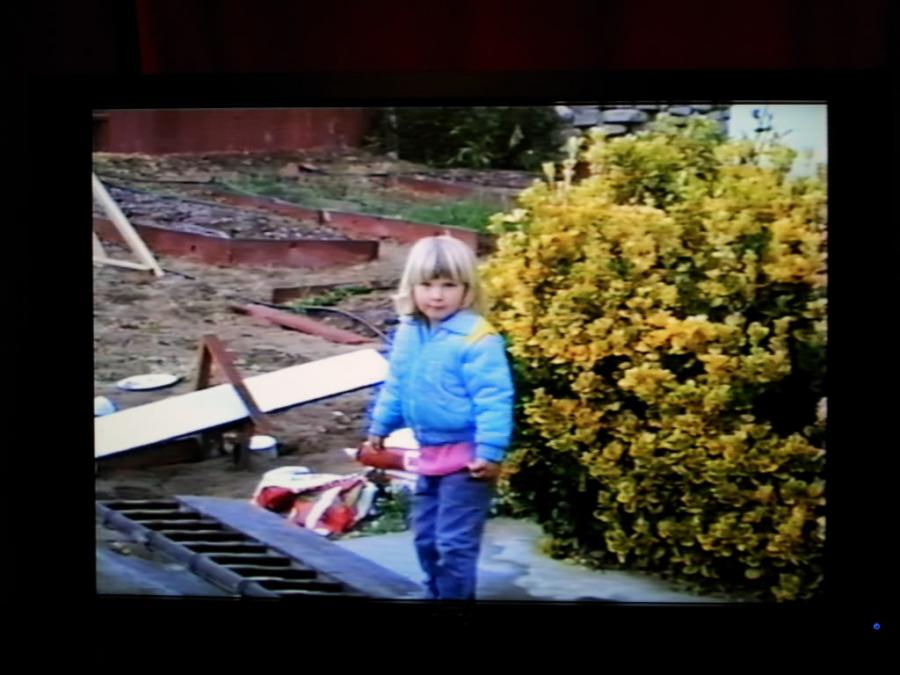
I do have a specific question that has been bothering me. I captured the video with a JVC SR-V10 S-VHS player in huffyuv with Virtualdub. When I play these files on my computer, the video aspect ratio is a bit wider than what I get when I encode to MPEG with 4:3 ratio set. The resulting video looks horizontally compressed. I would rather have an encode that is a bit wider than the MPEGs I am getting. One thing I have tried is to encode at 16:9 but put black borders on the left and right side. If I do this, the video aspect ratio looks about right. What is your opinion about this? What are the downsides to encoding at 16:9 with black borders? Am I losing image quality?
Here is an example of what happens to the video. This image is of me playing back the huffyuv file on my monitor:
And this image is me playing back an MPEG I encoded from that same source:
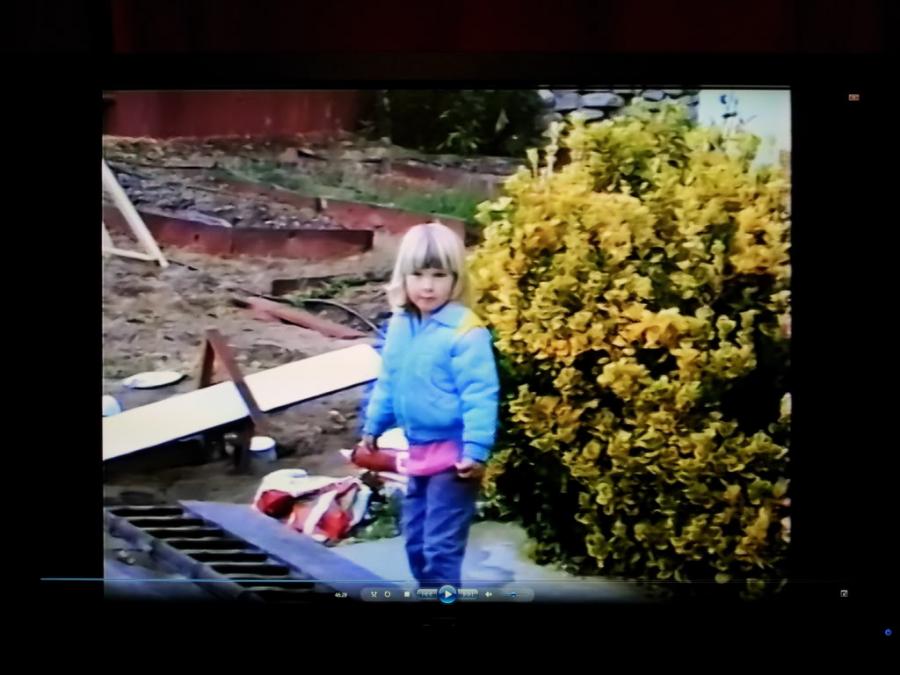
Why does the second image look so squished compared to the first? The only way I can make an encode look like the original image is to encode in 16:9 with black borders on the right and left sides of the image.
What are your thoughts on this?
I look forward to reading your response.
|
|
11-06-2011, 03:40 PM
|
|
Site Staff | Web Hosting, Photo
|
|
Join Date: Feb 2004
Posts: 4,311
Thanked 374 Times in 341 Posts
|
|
Quote:
Originally Posted by jrodefeld
I cannot say for sure what device was used. It belonged to my grandmother. It was a late 80s device that recorded to SP VHS tapes. Is there some way I can determine whether it is TFF or BFF? Or could we make an educated guess? Maybe you could elaborate. I don't even know what that means.
|
Interlace field dominance. Top = TFF, Bottom = BFF. Most DVD recorders and capture cards are top, DV is bottom.
I wanted to know what device was used to capture the video. Not record it originally.
Then I could answer several questions, based on that. 
- Did my advice help you? Then become a Premium Member and support this site.
- Please Like Us on Facebook | Follow Us on Twitter
- Need a good web host? Ask me for help! Get the shared, VPS, semi-dedicated, cloud, or reseller you need.
|
|
11-06-2011, 05:41 PM
|
|
Free Member
|
|
Join Date: Jun 2011
Posts: 40
Thanked 1 Time in 1 Post
|
|
Quote:
Originally Posted by kpmedia
Interlace field dominance. Top = TFF, Bottom = BFF. Most DVD recorders and capture cards are top, DV is bottom.
I wanted to know what device was used to capture the video. Not record it originally.
Then I could answer several questions, based on that. |
Oh, okay. I understand what you mean, I just never heard the terms TFF or BFF. I captured the video with an ATI TV Wonder 650 PCI capture card. The source was a SR-V10 S-VHS player. My PC shows the captured footage as bottom frame dominant.
Thanks for clearing that up. I look forward to hearing your suggestions.
|
|
11-07-2011, 08:18 PM
|
|
Site Staff | Web Hosting, Photo
|
|
Join Date: Feb 2004
Posts: 4,311
Thanked 374 Times in 341 Posts
|
|
|
The ATI 650 card should be TFF, not BFF. I'd go so far as to say anything reporting BFF is simply confused or outright wrong.
The network has been slow all day (a major bandwidth carrier had some kind of hiccup), and it's still laggy. I'll have to address this tomorrow. With the information given now, I can go over your MainConcept Reference MPEG-2 encoding settings, and give some advice on what's been done right, what's been done wrong, and what may have some optional tweaks to improve. Sit tight, and I'll have some good info for you soon.
Thanks.
- Did my advice help you? Then become a Premium Member and support this site.
- Please Like Us on Facebook | Follow Us on Twitter
- Need a good web host? Ask me for help! Get the shared, VPS, semi-dedicated, cloud, or reseller you need.
|
|
11-07-2011, 08:24 PM
|
|
Free Member
|
|
Join Date: Jun 2011
Posts: 40
Thanked 1 Time in 1 Post
|
|
Quote:
Originally Posted by kpmedia
The ATI 650 card should be TFF, not BFF. I'd go so far as to say anything reporting BFF is simply confused or outright wrong.
The network has been slow all day (a major bandwidth carrier had some kind of hiccup), and it's still laggy. I'll have to address this tomorrow. With the information given now, I can go over your MainConcept Reference MPEG-2 encoding settings, and give some advice on what's been done right, what's been done wrong, and what may have some optional tweaks to improve. Sit tight, and I'll have some good info for you soon.
Thanks.
|
Thanks for updating me. I look forward to your input.
|
|
11-09-2011, 12:06 PM
|
|
Site Staff | Video
|
|
Join Date: Dec 2002
Posts: 13,661
Thanked 2,461 Times in 2,093 Posts
|
|
Video is never simple. Some of what you're observing is actually unrelated to MainConcept or even video encoding in general.
720x480 video is 3:2 aspect -- wider than normal. The images you're viewing above should be correct.
The "squished" image is actually properly sized; proper aspect; proper ratio; proper geometry.
If you view 720x480 at native storage aspect, instead of proper 4:3 or 16:9 playback aspect, you'll have several problems:
1. You might edit it improperly: Trying to change geometry, not realizing your already viewing it in the wrong geometry.
2. You might get accustomed to seeing the world "wrong" (stretched fat by 10%) and think anything proper is hence wrong.
I readily admit to having done both of these things -- and subsequently having to fix or redo it.
You've likely fallen into #2, and hopefully you didn't alter the video shape to also be victim to the #1 problem.
Did you?
Some of your settings are so aggressive as to do little more than add encoding time, with virtually no quality gains. For example, the "P/Q 31 slowest/best" encoding PQ speed. That's really not necessary. A setting of 16 is fine, 24 would be better, 31 just makes it take forever. This setting is less important than have 2-pass VBR at a good bitrate.
Your video is top-field first. Change to TFF -- don't use bottom/BFF.
I've never seen any real difference among the GOP placement settings, so SCD Fast is fine.
At this bitrate, I'd change the discreet cosine (DC) to 10-bit, not default 9-bit.
You can change the pixel search mode settings, which makes it take longer to encode, but with potentially better (more accurate) encoding. Sub pixel full. Search mode 15. Search range is fine at default (39), but raise it as much as 63 if you want. Noise sensitivity actually has more effect than the other number settings here: set to 3.
The input format should be automatically detected, no reason to specify it here again on that last tab. But you can, if you want to.
Bitrate and the DVD-Video specs themselves will always be the primary limiter on quality possible from shaky home movies.
That's one reason we're working with H.264 so much these days (and therefore Blu-ray and BD-R/BD-RE, as an extension), to compare how well that may work instead. You can always surpass DVD specs, for the MPEG-2 encodes (15Mbps max) and simply not author to DVD. Of course, that somewhat defeats the purpose of "converting" from one watchable format to another, or the ability to easily give out copies to family members.
I don't really see any major mistakes on your part, aside from the field dominance selection. (That would have been a mess view on normal TV.)
Apologies that it took so long to respond. Some of the ongoing projects in Oct-Nov simply turned out more time-consuming than projects. That's how it goes with video work, sometimes. You can quote and estimate all you want, but ultimately the videos themselves (and the equipment, too) determine how fast something happen. You're finding that out, I would imagine, from your own homemade projects. Having fun yet?!
Encode away. 
|
All times are GMT -5. The time now is 08:51 AM
|





